
Medically reviewed by Dr. Eugene Bernstein, DDS, Founder of Gentle Dental of NJ, 24+ Years Experience | Last Updated: April 2026
Quick Answer
An endodontist is a dental specialist with two to three additional years of training beyond dental school, focused entirely on the inside of the tooth: the nerve, pulp, and root canal system. You see an endodontist (instead of a general dentist) for complex root canals, retreatments, dental trauma, and tooth-saving procedures when a routine root canal is not the right fit. For most first-time root canals on a single-rooted tooth, your general dentist can handle the procedure in-office.
If you searched “endodontist near me” or “what is an endodontist,” you are likely in one of three situations: a general dentist referred you for a complex case, you have severe tooth pain and are not sure who to call, or a previous root canal failed and you need a retreatment. This guide explains what endodontists actually do, how the specialty differs from general dentistry, when a referral makes sense, and when your general dentist can handle the case directly.
Answers throughout draw on clinical practice from Dr. Eugene Bernstein, DDS, founder of Gentle Dental of NJ in Newark, who has performed root canal treatments and complex restorative work for over 24 years.
What Is an Endodontist
An endodontist is a dental specialist who completed dental school (a four-year DDS or DMD degree) PLUS an additional two to three years of advanced training in endodontics, the branch of dentistry focused on the dental pulp and the tissues around the tooth root. About 3% of all U.S. dentists are board-certified endodontists.
The word comes from Greek: “endo” (inside) plus “odont” (tooth). Their entire clinical scope is the inside of the tooth and the bone immediately around the tooth root.
What that translates to day-to-day:
- Root canal therapy, about 95% of an endodontist’s volume
- Retreatment of failed prior root canals
- Apicoectomy (surgical root-tip removal when standard root canal is not enough)
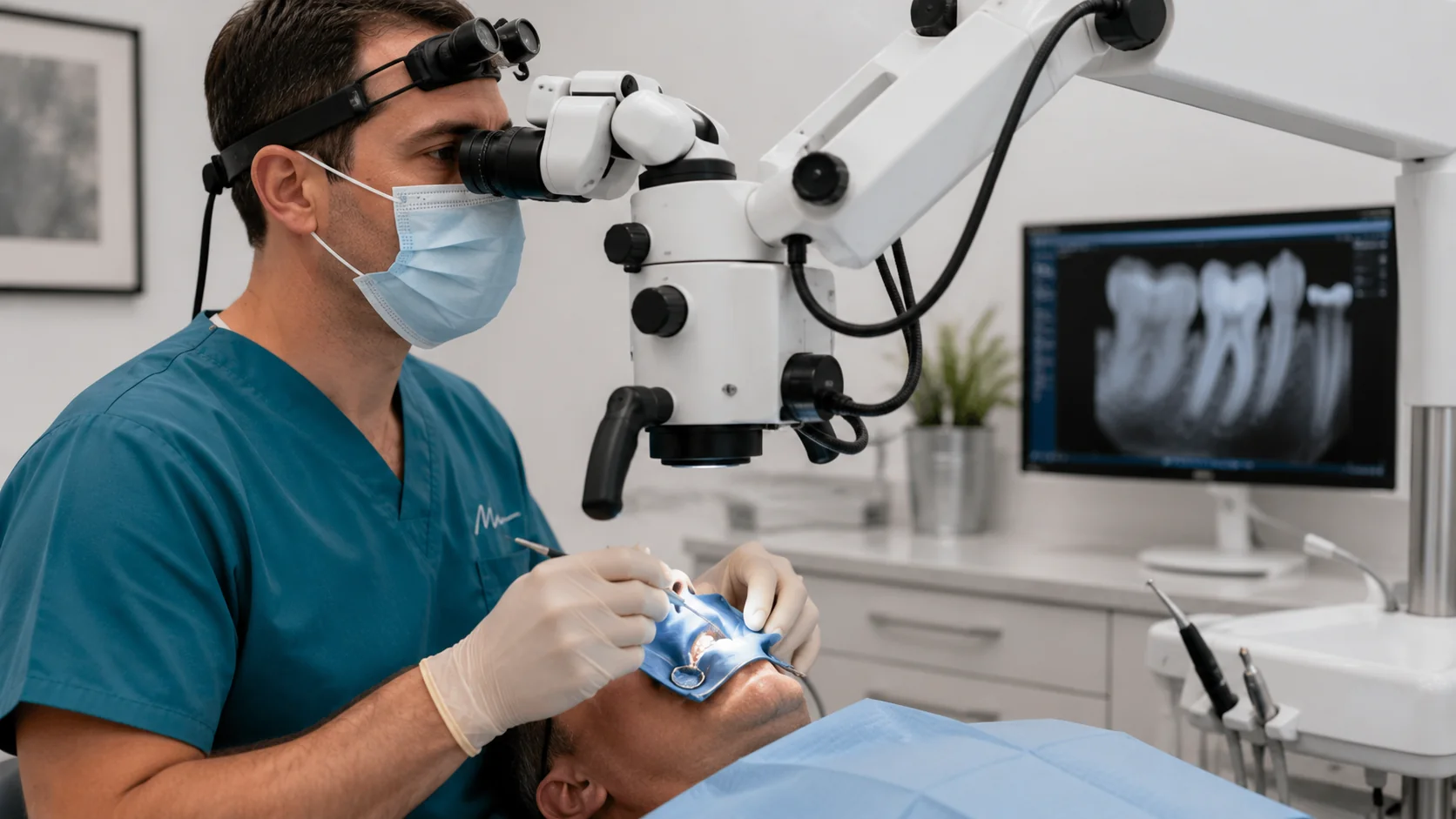
- Cracked tooth diagnosis using high-magnification microscopes
- Dental trauma management (knocked-out teeth, vertical fractures)
- Internal bleaching for darkened root-canal-treated teeth
- Use of cone-beam CT for 3D root canal anatomy mapping
Endodontist vs General Dentist: Who Does What
| Treatment | General Dentist | Endodontist |
|---|---|---|
| Routine root canal (front tooth, single canal) | Yes (most cases) | Yes |
| Routine root canal (premolar, two canals) | Yes (most cases) | Yes |
| Molar root canal (3-4 curved canals) | Sometimes; often refers | Yes |
| Retreatment of a failed root canal | Refers | Yes |
| Cracked tooth diagnosis | Initial assessment | Definitive diagnosis |
| Apicoectomy (root-tip surgery) | Refers | Yes |
| Knocked-out tooth (avulsion) | Reimplants if same-day | Long-term root management |
| Crown after root canal | Yes | No (refers back) |
| Cleanings, fillings, exams | Yes | No |
| Implants, extractions, crowns, dentures | Yes | No |
The mental model: an endodontist is to root canals what a heart specialist is to cardiac care. Most general practitioners can manage the routine cases competently, but anything complex or repeat-treatment goes to the specialist with the better tools and the focused expertise.
When Should I See an Endodontist?
The clearest signals you should see an endodontist (vs your general dentist) for tooth pain or root canal needs:
- Your general dentist referred you. Dentists usually refer when they see complex anatomy on the X-ray, when initial treatment failed, or when surgical intervention is likely needed.
- You need a retreatment of a previous root canal. Retreatments require the careful removal of old filling material and have a higher failure rate than first-time treatments. Endodontist tools (microscopes, ultrasonic instruments) make a meaningful difference.
- You have severe trauma to a tooth (knocked out, displaced, fractured root). Time-sensitive; call same-day.
- The tooth in question is a molar with curved or extra canals visible on the X-ray. Some upper molars have a fourth canal (MB2) that is technically demanding to find and clean.
- You have unexplained tooth pain that the general dentist cannot pinpoint after exam and X-ray. Endodontists have specialized diagnostic tools (electric pulp tester, cone-beam CT) that can localize the source.
- You suspect a cracked tooth. Vertical root fractures often need an endodontist’s microscope to confirm.
When Your General Dentist Can Handle the Root Canal
Routine root canals on single-canal teeth (front teeth, premolars, some molars with simple anatomy) are well within general dentist scope. About 70% of all root canals in the U.S. are performed by general dentists, not endodontists.
Reasons to stay with your general dentist for the procedure:
- You already have an established relationship and trust
- The case is straightforward (single canal, no infection signs, clear X-ray)
- The same office can do the crown afterward (continuity of care)
- Insurance coverage is often better with the in-network general dentist
- Cost is typically 20 to 40 percent lower than an endodontist for the same routine procedure
For pricing context on routine cases, see our breakdown of how much does a root canal cost.
What Happens If You Skip Treatment
Tooth pain caused by an inflamed or infected pulp does not resolve on its own. The available paths are:
Root canal (general dentist or endodontist), saves the natural tooth, success rate 86 to 98% depending on case complexity and operator skill. Most root-canal-treated teeth function for decades.
Tooth extraction followed by implant or bridge, removes the natural tooth and replaces it. Effective but requires more procedures, more healing time, and higher total cost.
No treatment, pain typically worsens, infection can spread to surrounding bone (an abscess), and in rare cases bacterial infection can spread to the bloodstream. Skipping is not a stable option.
For a deeper look at the no-treatment scenario, see what happens if I don’t get a root canal.
How Much Does an Endodontist Cost vs a General Dentist
Endodontists charge 20 to 40 percent more than general dentists for the same routine root canal because of higher overhead (microscope, cone-beam CT, ultrasonic equipment) and the specialty training premium.
| Tooth / Procedure | General Dentist | Endodontist |
|---|---|---|
| Front tooth (incisor) | $700 to $1,100 | $900 to $1,400 |
| Premolar (bicuspid) | $800 to $1,300 | $1,000 to $1,600 |
| Molar | $1,000 to $1,800 | $1,300 to $2,200 |
| Retreatment | Refers | $1,200 to $2,400 |
| Apicoectomy | Refers | $900 to $1,800 |
Insurance typically covers root canal therapy as a basic restorative service whether it is performed by your general dentist or an endodontist, but the patient out-of-pocket can differ based on in-network status.
What to Bring to Your Endodontist Appointment
If you have been referred:
- The referral letter or notes from your general dentist, if provided
- Recent dental X-rays, ideally within the last 6 months. Your general dentist’s office can email these.
- List of medications you take regularly
- Insurance card and a backup payment method
- List of allergies, especially to anesthetics or antibiotics
The first visit is typically a consultation plus diagnosis. The actual root canal is usually scheduled separately, although some endodontists perform it the same day if scheduling allows.
Endodontist Visit: What Actually Happens
- Local anesthesia, same as a routine filling. The endodontist may use multiple anesthetic injections to ensure complete numbness, especially for inflamed teeth which can be harder to fully anesthetize.
- Rubber dam placement, a thin sheet of latex isolates the affected tooth from saliva.
- Access opening, a small opening through the top (or back) of the tooth into the pulp chamber.
- Cleaning and shaping, fine instruments under microscope magnification remove the inflamed or infected pulp tissue from each canal. Often takes 60 to 90 minutes for a molar.
- Filling and sealing, a rubber-like material called gutta-percha fills each cleaned canal, sealed with a biocompatible cement.
- Temporary or permanent restoration, a temporary filling closes the access opening. Most teeth need a permanent crown afterward, placed by your general dentist.
Most patients are surprised that the procedure feels similar to a long filling appointment, with no pain during and only mild soreness for one to three days afterward.
How Gentle Dental of NJ Approaches Root Canal Cases
Dr. Bernstein and the team at Gentle Dental of NJ in Newark perform routine root canals in-office and refer complex cases or retreatments to specialty endodontists when the case warrants. The decision is made on the diagnostic X-ray plus exam findings, and we explain the recommendation clearly so you understand whether the procedure happens in our office or with a referred specialist.
For patients across Newark including Ironbound, Forest Hill, Vailsburg, and Weequahic, the practice’s 24-year tenure and continuity of care across exam, treatment, and crown placement is a meaningful advantage when a single root canal turns into a longer treatment plan.
Severe tooth pain or considering a root canal? Call Gentle Dental of NJ at (973) 817-8888 for a same-day evaluation, or visit our office at 290 Ferry Street, Newark, NJ. We will diagnose the situation, recommend in-office treatment or specialist referral as appropriate, and walk you through cost and timing. Schedule a consultation.
Frequently Asked Questions
What is the difference between an endodontist and a regular dentist?
An endodontist is a dental specialist with two to three additional years of training after dental school, focused entirely on the dental pulp and root canal system. Regular dentists handle a broader scope including cleanings, fillings, crowns, and extractions, plus routine root canals on simpler cases. Endodontists handle complex root canals, retreatments, and surgical cases.
Can my general dentist do my root canal or do I need an endodontist?
For routine first-time root canals on front teeth, premolars, and many molars, your general dentist can handle the procedure. About 70% of root canals in the U.S. are performed by general dentists. Endodontist referral makes sense for complex anatomy, retreatments, surgical cases, and cases your general dentist flags as outside their scope.
Is an endodontist more expensive than a general dentist?
Yes, typically 20 to 40 percent more for the same routine root canal due to specialty training and equipment overhead (surgical microscopes, cone-beam CT, ultrasonic instruments). Insurance usually covers root canals at the same percentage regardless of provider type, but in-network status affects out-of-pocket cost.
What does an endodontist do besides root canals?
About 95% of endodontic practice is root canal therapy and retreatment. The remaining work includes apicoectomy (surgical root-tip removal), dental trauma management (knocked-out teeth, fractures), cracked tooth diagnosis using surgical microscopes, and internal bleaching for darkened root-canal-treated teeth.
How long does an endodontist take to do a root canal?
A simple front-tooth root canal runs 45 to 60 minutes. A molar with three or four canals typically runs 60 to 90 minutes per session. Some cases are completed in a single visit; others require two visits separated by one to two weeks for complete healing of an active infection.
Do I need a crown after seeing an endodontist?
Most root-canal-treated teeth need a crown afterward, placed by your general dentist (the endodontist does not place crowns). The crown protects the now-hollow tooth from fracturing under chewing forces and restores normal function and appearance. Front teeth sometimes need only a filling.
This article is for informational purposes only and is not a substitute for professional dental advice, diagnosis, or treatment. Always consult with a qualified dental provider regarding any oral health concerns.